|
The research topics investigated include:
1) The processing of taste and olfactory information by the brain.
2) The processing of visual information about objects by the brain.
3) A theory and model of how the visual system performs invariant visual
object recognition.
4) A theory of emotion and motivation, and analysis of the operation of the brain
systems including the amygdala and orbitofrontal cortex, which are involved
in emotion.
5) The application of understanding brain mechanisms of emotion and
emotion-related learning to the understanding and rehabilitation of
patients with damage to the inferior parts of the frontal lobes.
6) The operation of the brain systems, including the hypothalamus,
orbitofrontal cortex, and amygdala, involved in the control of food and
water intake.
7) Where and how sensory signals are decoded into reward signals in the brain,
and the neural mechanisms that underlie reward.
8) The neural mechanisms that underlie memory in the brain. The
operation of key structures in the brain in memory, including the
hippocampus, orbitofrontal cortex, and amygdala.
9) A full theoretical treatment of how the hippocampus could store
episodic memories, and how they could be recalled to the neocortex to thus
contribute to the formation of long-term memories.
10) The information which reaches the striatum from the neocortex, and
the implications of this for understanding the operation of the basal
ganglia.
11) How information is encoded by the firing of neurons in many
different brain systems.
12) The ways in which many parts of the cerebral cortex may actually work, by
combining neurophysiological, neuroanatomical,
connectivity, and biologically plausible neuronal network approaches.
Biologically plausible computation in the brain compared with that in digital computers and used in artificial intelligence.
13) The brain mechanisms of attention and decision-making.
14)
The neural bases of mental disorders including depression,
schizophrenia and autism, with implications for treatment. This builds
on the research described above, and adds new large-scale analyses of
neuroimaging data from patients and controls.
15) Brain process involved in consciousness, and the relation between the brain and the mind.
16) Aesthetics and the brain.
Many of these advances are summarized in nine books:
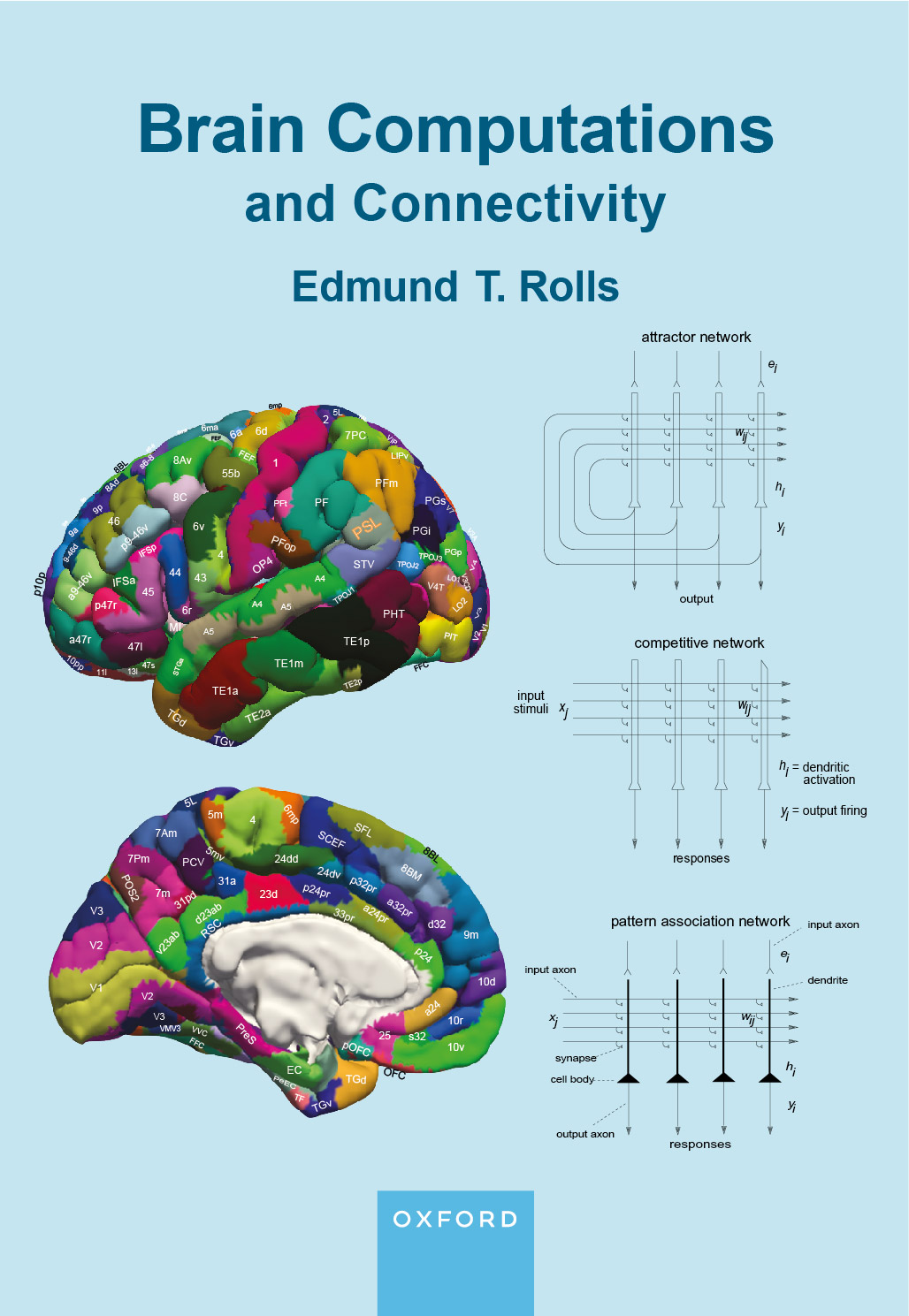
Brain Computations and Connectivity by E. T. Rolls, 2023, Oxford University Press;
Brain Computations: What and How by E. T. Rolls, 2021, Oxford University Press;
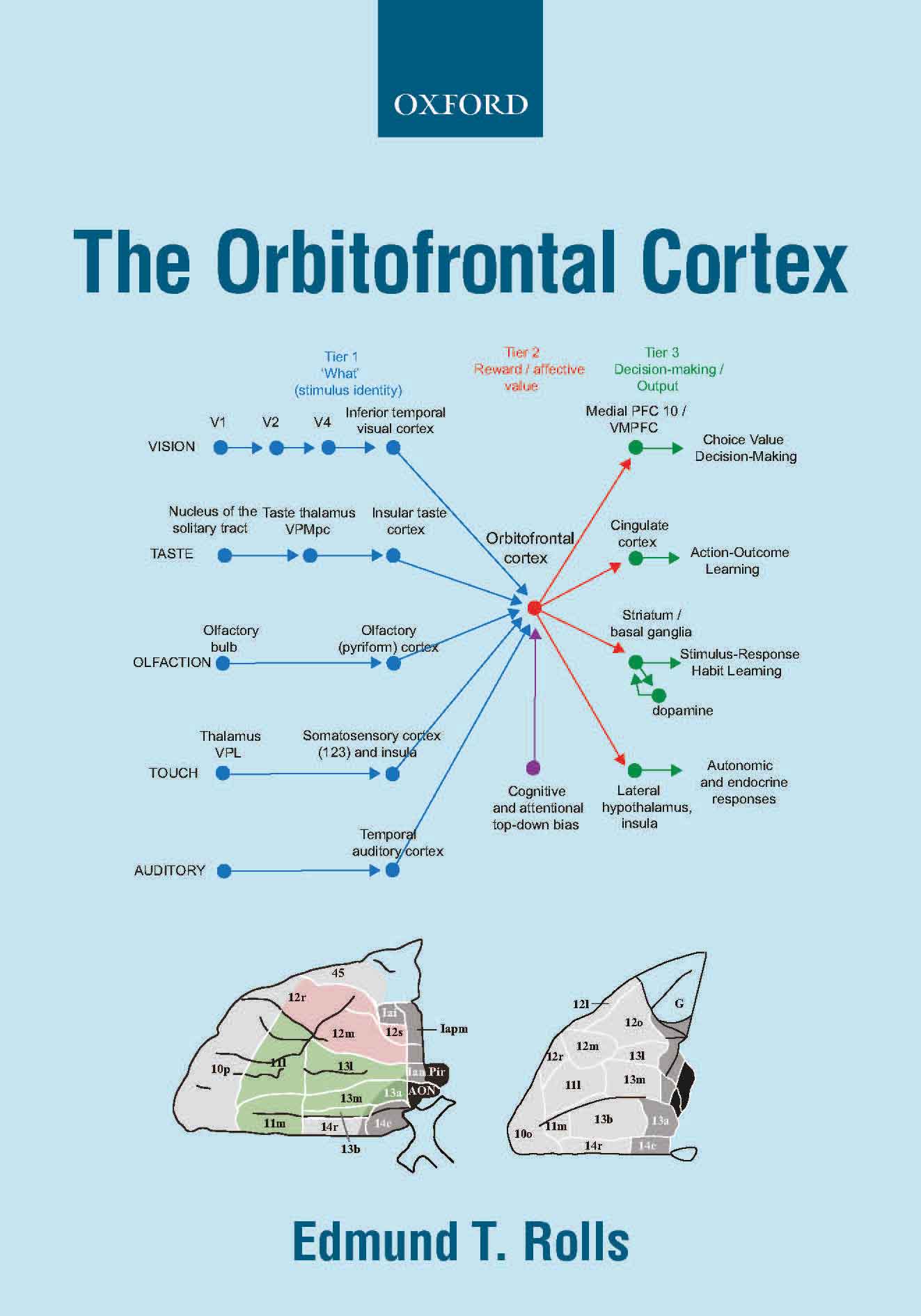
The Orbitofrontal Cortex by E. T. Rolls, 2019, Oxford University Press;
The Brain, Emotion, and Depression by E. T. Rolls, 2018, Oxford University Press;
Cerebral Cortex: Principles of Operation by E. T. Rolls, 2016, Oxford University Press;
Emotion and Decision-Making Explained by E. T. Rolls, 2014, Oxford University Press;
The Noisy Brain: Stochastic Dynamics as a Principle of Brain Function by E. T. Rolls and G.Deco, 2010, Oxford University Press;
Computational Neuroscience of Vision by E.T.Rolls
and G.Deco, 2002, Oxford University Press;
Neural Networks and Brain Function by E. T. Rolls
and A.Treves, 1998, Oxford University Press;
and are described in the papers
shown in the List of Publications.
17) Accessible communication of neuroscience.
Edmund Rolls has written a book that
is intended to consider some of the implications of modern research in
neuroscience in part to an audience beyond neuroscience:
Neuroculture: On the Implications of Brain Science by E.T.Rolls, 2012. Oxford University Press. Neuroculture.pdf.
Edmund Rolls has written a book
intended to explain current understanding of the brain, emotion, and
depression with a new type of format, with sections coloured blue for
nonspecialists who may be interested to know for example about some of
the bases and treatments for depression:
The Brain, Emotion, and Depression by E.T.Rolls (2018) Oxford University Press.
|